

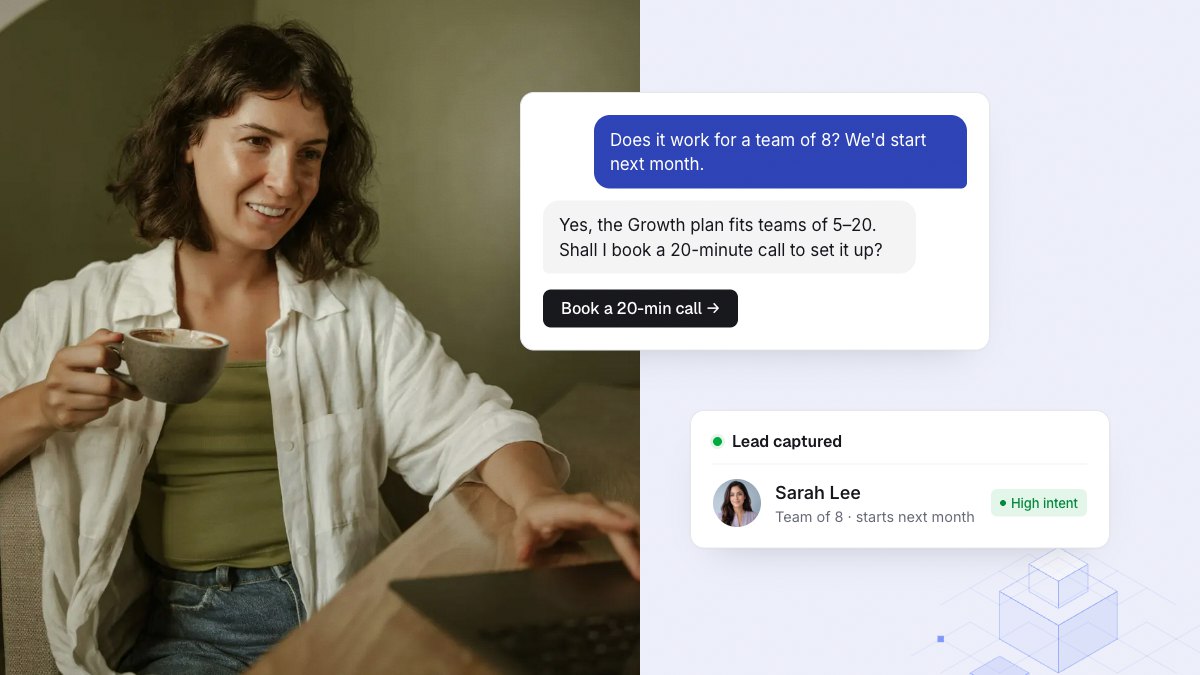
Most conversion problems are not caused by a missing button. They happen because a visitor has a question, a doubt, or an edge case that the page does not answer quickly enough. Website chat gives that moment somewhere useful to go.
It answers questions before visitors leave
Pricing pages, product pages, and landing pages ask visitors to make decisions with incomplete context. A good chat experience closes that gap by answering questions about fit, implementation, plans, integrations, or next steps while the visitor is still engaged.
The benefit comes from speed and relevance. Instead of searching through documentation, waiting for a reply, or leaving to compare alternatives, the visitor receives a direct answer and a clear route forward.
It captures intent, not only contact details
Forms usually collect the minimum: a name, an email address, and perhaps a company. A conversation can capture the useful context behind the form, including what the visitor is trying to solve, how urgent it is, which capability matters, and whether they are ready for sales or still researching.
Better context means faster follow-up, cleaner routing, and fewer generic discovery calls.
That context also helps teams prioritize. A visitor asking about an enterprise rollout should not enter the same follow-up queue as someone looking for a basic support answer.
It turns the next step into a recommendation
Visitors do not always know whether they should book a demo, start a trial, read a guide, compare plans, or talk to support. Website chat can use the question, current page, and conversation history to recommend the next best action.
This matters because a single landing page cannot be the perfect path for every visitor. Conversation makes the journey more adaptive without requiring a different page for every possible need.
It helps teams respond while intent is fresh
A qualified visitor asking about pricing, implementation, or a specific use case is showing intent. If that conversation is summarized and routed quickly, the team can respond with useful context rather than beginning with a generic follow-up.
- Route demo-ready visitors to sales.
- Send product questions to the right owner.
- Capture trial interest even when the team is offline.
- Keep lower-intent visitors moving with relevant resources.
The best chat experiences feel like part of the page
Website chat should not feel like a separate support tool bolted onto a marketing site. It should match the brand, understand the page context, and offer actions that fit the visitor's journey.
When it does, chat becomes more than a message box. It becomes a conversion layer that helps people move from curiosity to clarity, and from clarity to action. The strongest starting point is one focused visitor journey with a measurable outcome; additional paths can follow after the first experience is working.
See the Zeltino plans or follow the quick setup guide to plan the first conversation.